The Cold War
What was the Cold War?
 The Cold War was a conflict between the Soviet Union and Western democracies that lasted forty years after the end of the Second World War. In the late 1940s it became apparent that the oppression of people in Soviet-occupied Europe under communism was incompatible with Canadian values.
Along with the United States, Great Britain, and the western European nations, Canada decided to stand up against the Soviet Communist system.
Why was the Cold War 'cold'?
Unlike the Second World War and previous conflicts, the Cold War never became a “hot” war. The destructive power of nuclear weaponry had been proven to devastating effect after the bombing of Nagasaki and Hiroshima at the end of the Second World War. During the Cold War, the Western nations and the Soviet Union both held nuclear weapons and were prepared to fight if they had to.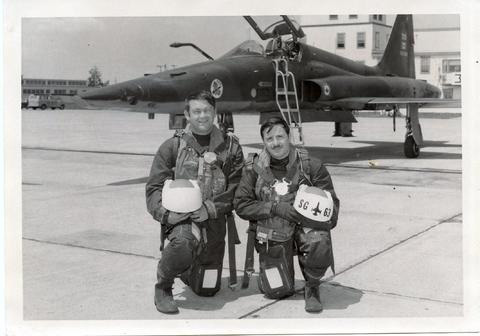
NATO
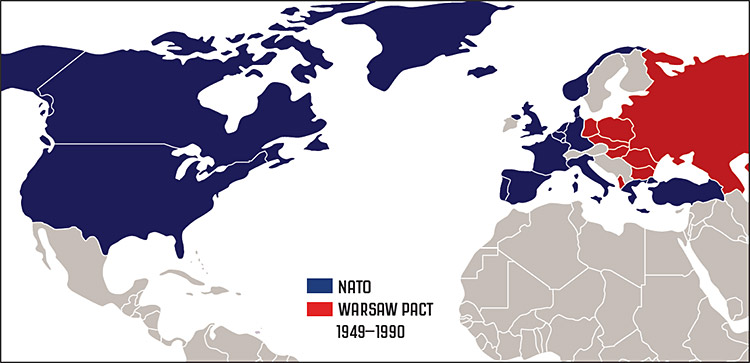
In response to the threat the Soviet Union posed to Western Europe after the Second World War, the North Atlantic Treaty Organization (NATO) was formed in 1949, of which Canada was a founding member. NATO emerged as a result of a combination of Soviet interference and threats of war against Western European countries.NATO’s basis was enshrined in the North Atlantic Treaty’s Article 5, which explicitly stated that an attack against one member of NATO was an attack against all members of NATO, thus inextricably linking Canada and Western Europe. Even after the dissolution of the Soviet Union in 1991, the NATO alliance remains the most important deterrent against Russian aggression into Western Europe.
NATO Founding Members:
Belgium
Canada
Denmark
France
Iceland
Italy
Luxembourg
Netherlands
Norway
Portugal
United Kingdom
United States
Warsaw Pact
When West Germany was remilitarized on 9 May 1955 and accepted into NATO, the Soviet Union organized the Warsaw Pact, stating that a remilitarized West Germany was a threat to peace and safety. The Warsaw Pact was signed on 14 May 1955 as a collective defence treaty between Eastern European countries and the Soviet Union. By unifying their militaries under one banner, the Soviet states would be on equal terms with NATO.Warsaw Pact Countries:
Bulgaria
Czecholovakia
East Germany
Hungary
Poland
Romania
Soviet Union
Cold War Escalation
During the Cold War, several crises developed between the Soviet Union, its allies, and the Western powers. In these periods, Canada had to increase its readiness in case of an attack. The best-known is the Cuban Missile Crisis in 1962 between the United States and the Soviet Union.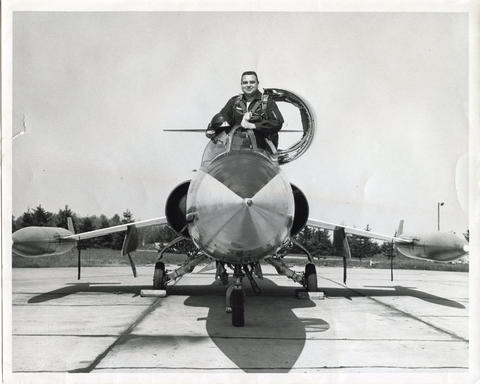
On October 14, 1962, Castro, wary of America and the last invasion, made a deal with the Soviet Union to build nuclear launch facilities on Cuban soil. This frightened America, whose territories were within easy striking distance of the nuclear weapons.
After thirteen days of tension, the Soviet Union and America came to an accord – the Soviets would withdraw all nuclear weapons from Cuba, in return for America doing the same with their weapons in Turkey. This incident, known as the Cuban Missile Crisis, was dangerously close to turning the Cold War into a hot one.
Canada’s Nuclear Role
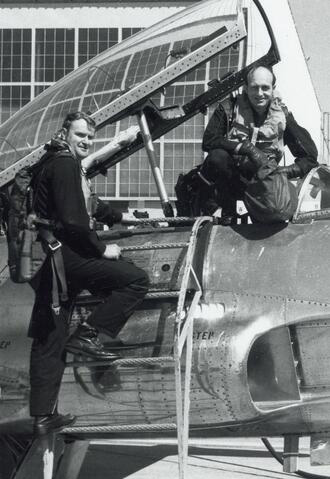 Soviet military forces were vast compared to NATO forces in the 1950s and 1960s. NATO countries adopted nuclear weapons to ensure deterrence. Changes in restrictive American laws meant that American nuclear weapons could be deployed to non-American forces, like Canada. As a result, select pilots of 1 Air Division were chosen for conversion from the conventional role of the Sabre fighter to the nuclear role of the CF-104 Starfighter.
Arctic Operations: DEW Line
In the early 1950s, when the threat of a Soviet attack by long-range bombers loomed over the North Pole, the United States and Canada agreed that a new radar network would provide early warning of such an attack. This network of radar stations, called the Distant Early Warning (DEW) Line, was developed in the far north along the shores of the Arctic ocean. It included 42 radar sites in the Canadian Arctic divided into western and eastern sectors.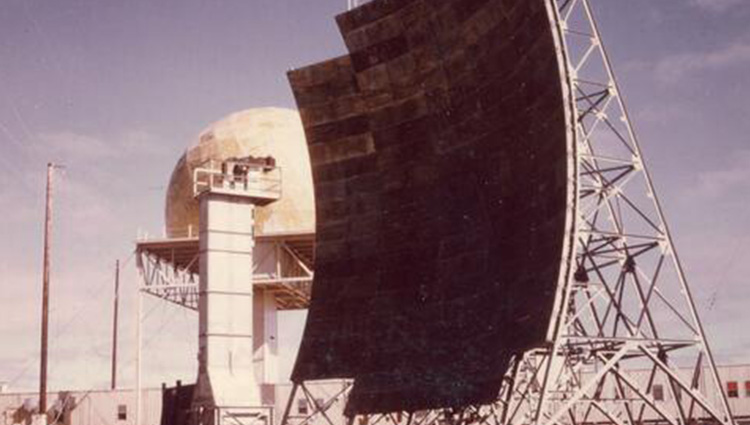
Construction of the DEW line was a logistical challenge requiring thousands of transport flights to airlift supplies to these remote locations in the far north. Flying was often hazardous due to marginal weather conditions, poorly marked landing strips and mechanical failures. Pilot error also contributed to a higher than normal accident rate. More than 60 aircraft and 26 lives were lost during the two and a half of years it took to build the DEW Line.
By the mid-1980's, after thirty years of service, the DEW Line had become largely obsolete and was eventually replaced by the North Warning System, a joint U.S. and Canadian early warning radar system. Clean-up of the abandoned DEW Line sites was undertaken and completed in 2014 at a cost of over $550 million.